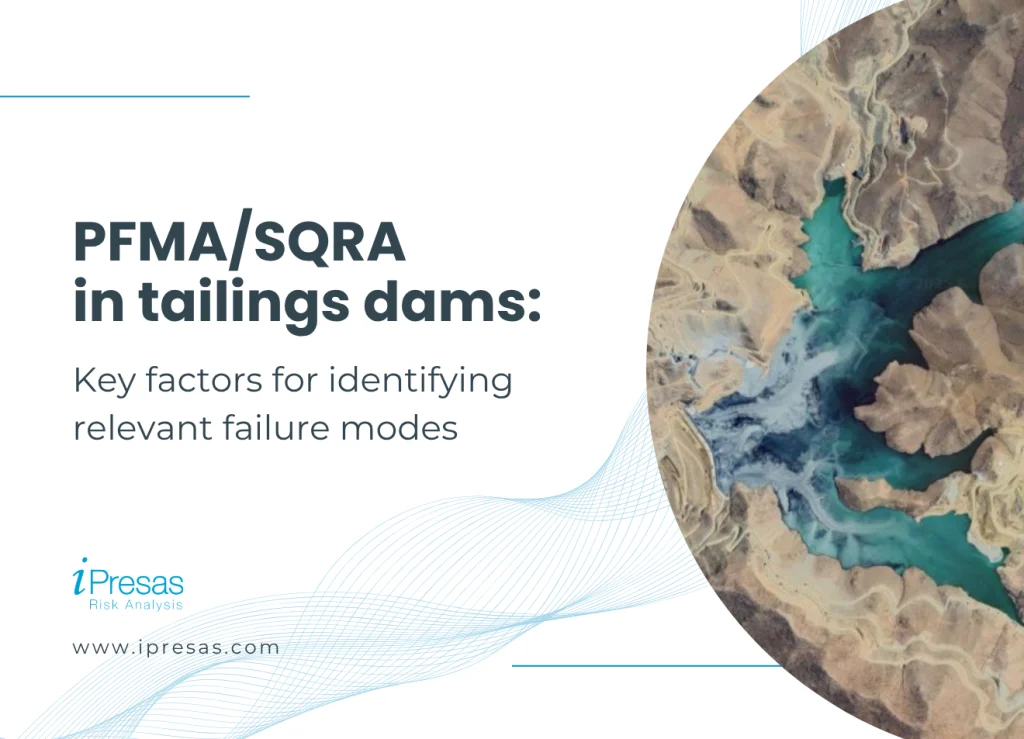
In the current mining context, tailings dam safety management has evolved from deterministic approaches towards risk-based methodologies. In this paradigm shift, PFMA (Potential Failure Modes Analysis), together with screening-level SQRA (Semiquantitative Risk Assessment), is positioned as a fundamental tool to understand how a facility can fail and, above all, to identify those failure modes that truly matter.
But how is an effective PFMA/SQRA carried out in tailings dams? And what are the keys to identifying the predominant failure modes or “risk drivers”?
What is PFMA/SQRA and why is it critical in tailings?
PFMA is a structured process that allows the identification, description and qualitative evaluation of potential failure modes of an infrastructure. In practice, this process is developed in an integrated manner with screening-level SQRA, incorporating from the outset a risk-oriented and decision-making perspective. In tailings dams, where multiple disciplines are involved (geotechnics, hydraulics, operations, material chemistry), this phase is particularly critical.
It is not simply about listing potential failures, but about:
- Understanding the real physical mechanisms that may lead to failure
- Assessing their technical plausibility
- Identifying the factors that increase or reduce their probability
- Prioritising those that may become risk drivers
From PFMA/SQRA to risk: an iterative process
PFMA/SQRA is not an isolated exercise nor merely a preliminary stage, but rather the starting point for more advanced analyses such as SQRA or QRA when required. In this context:
- An initial selection of potential failure modes (PFMs) is carried out
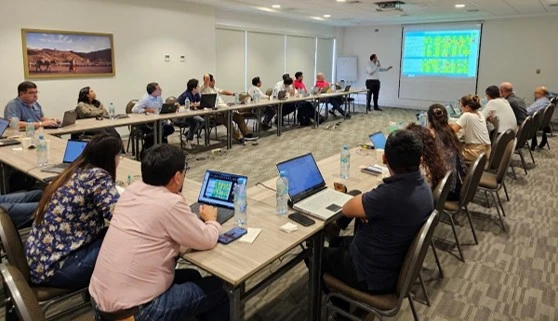
- These are reviewed in detail during expert workshops
- Predominant failure modes (risk drivers) are identified for in-depth analysis
In many cases, this level of analysis is sufficient to identify the main risk drivers and support decision-making, without the need to move to more complex analyses. This iterative process allows refining the assessment and focusing efforts on the scenarios that truly govern the overall risk of the facility.
Key factors for identifying relevant failure modes
Below are the key factors that determine the quality of a screening-level PFMA/SQRA in tailings dams:
1. Multidisciplinary approach
Failure modes in tailings rarely respond to a single cause. They are usually the result of interaction between:
- Geotechnical conditions (liquefaction, slope stability)
- Hydraulic conditions (seepage, overtopping)
- Operational factors (changes in construction method, drainage)
- Social and environmental factors
Therefore, PFMA must involve experts from different disciplines providing complementary perspectives.
2. Understanding tailings behaviour
Unlike conventional dams, tailings exhibit complex behaviour:
- Non-homogeneous materials
- Non-Newtonian behaviour in case of failure
- Temporal evolution of their properties
Identifying relevant failure modes requires understanding these behaviours and their influence on dam stability.
3. Critical review of available information
A robust PFMA is based on a thorough review of:
- Design documentation
- Operational history
- Monitoring data
- Previous studies
Additionally, it is essential to identify information gaps that may affect risk evaluation.
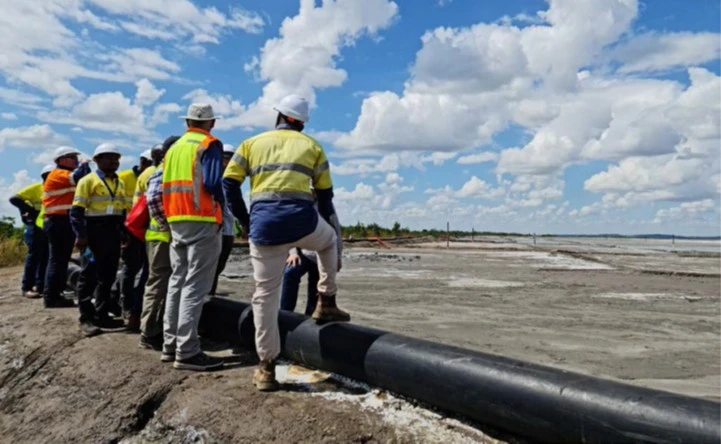
4. Validation through field inspection
Site visits are a key element:
- They allow validation of hypotheses developed in office work
- They identify real conditions not documented
- They provide direct evidence of potential failure mechanisms
The conclusions from these visits are essential to understand the selected failure modes.
5. Plausibility assessment (not all failures are equal)
One of the most common mistakes is to treat all failure modes with the same level of importance.
During PFMA it is necessary to analyse:
- Which modes are physically possible
- Which are more likely given the system conditions
- Which may lead to greater consequences
This process allows focusing on the true risk drivers.
From failure modes to decisions
The final outcome of PFMA is not merely a list of potential failure modes, but a prioritised selection of predominant failure modes that:
- Serve as a basis for defining risk reduction measures
- Facilitate prioritisation of actions and investments in safety management
- Feed quantitative risk analyses when a higher level of detail is required
In later stages, these modes are evaluated in detail through expert probability estimates and consequence analyses, enabling a comprehensive view of risk and supporting decision-making.
Conclusion
This type of analysis is much more than an initial stage in risk assessment: it is the process that defines the quality of all subsequent analysis and, in many cases, provides a sufficient level of detail for decision-making.
A well-executed screening-level PFMA/SQRA allows:
- Identification of the true risk drivers
- Prioritisation of actions and optimisation of resource allocation
- Supporting investment and management decisions
In a context where standards such as GISTM require active risk management, screening-level PFMA/SQRA becomes a key tool to move towards safer, more resilient and sustainable tailings management.