How Risk-Based Approaches Are Transforming Dam Safety
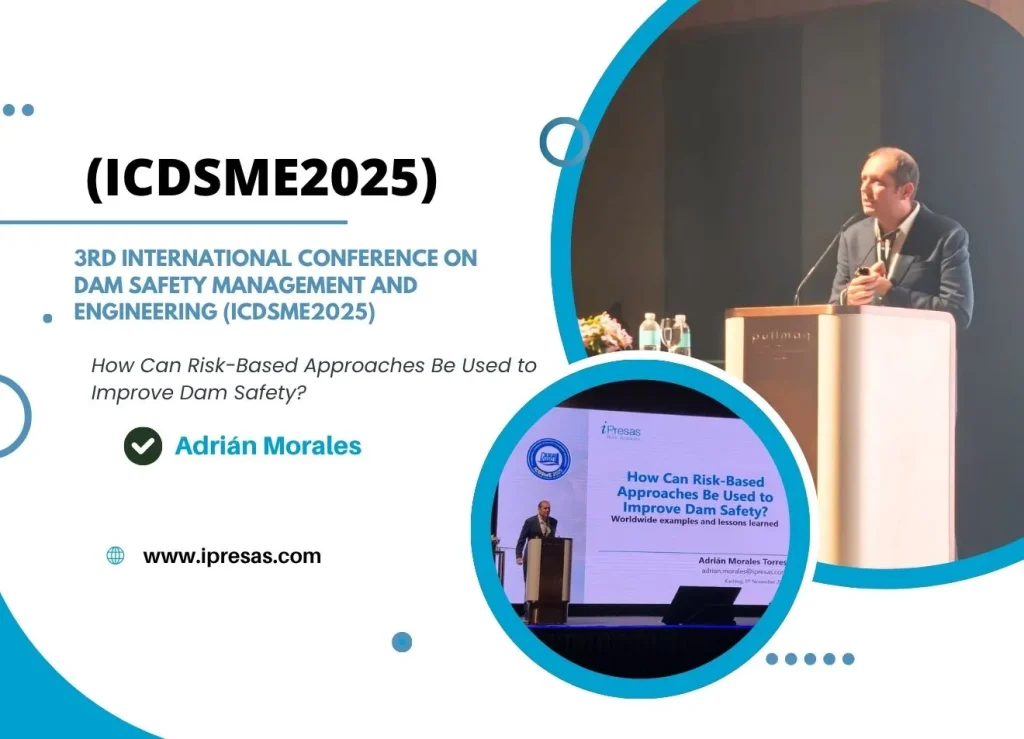
Dam safety today faces a dynamic environment shaped by ageing infrastructure, climate change, and resource pressure. In this context, Adrián Morales Torres participated as a keynote speaker at the ICDSME 2025 Congress, where he delivered the presentation titled “How Can Risk-Based Approaches Be Used to Improve Dam Safety? Worldwide Examples and Lessons Learned.”
Approach to Dam Safety
With this presentation, Adrián Morales aimed to explain how risk-based approaches allow us to go beyond traditional design and deterministic analysis by integrating the combination of probability and consequences to provide a more comprehensive view of dam safety.
Risk was defined as the combination of what could happen, the likelihood of it happening, and its consequences (economic, social, and environmental).
This framework enables a more structured assessment of natural, operational, or structural scenarios.
Key Methodologies Presented

Among the main tools highlighted in the presentation were:
Identification of potential failure modes through PFMA (Potential Failure Mode Analysis) and semiquantitative methodologies.
Alignment with international risk tolerability recommendations for dams and tailings dams, which require a comprehensive analysis of credible failure modes, the use of risk to inform decision-making, and periodic reviews.
Integration of multiple disciplines—hydrology, hydraulics, geotechnics, seismology, monitoring, and instrumentation—combined with quantitative models (e.g. event trees) that make it possible to estimate probabilities and consequences for different scenarios.
Evolution of Risk Over Time and Congress Context
In his address in Malaysia, Adrián Morales emphasized that a good risk-based management system must consider how the context changes: variations in extreme events, climate change, changes in water use, population growth, and infrastructure evolution.
This requires regular reviews and updates, as well as a proactive approach to risk management.
Benefits of Risk-Based Approaches
As demonstrated during the congress, the main benefits include:
Technical and policy innovation in dam management.
Comprehensive system view, encompassing loads, infrastructure, operation, and context.
Probabilistic reasoning that complements the traditional deterministic perspective.
More transparent, traceable, and defensible management before stakeholders.
Scalability: applicable from a single dam to portfolios or national networks, adaptable to various types of hazards.

Relevance for the Sector Attending ICDSME 2025
ICDSME 2025 confirmed a clear trend: moving toward dam safety that is increasingly supported by data, collaboration, and analysis.
Adrián Morales Torres’ presentation captured this shift well—managing better and more transparently, with direct benefits for water and infrastructure.