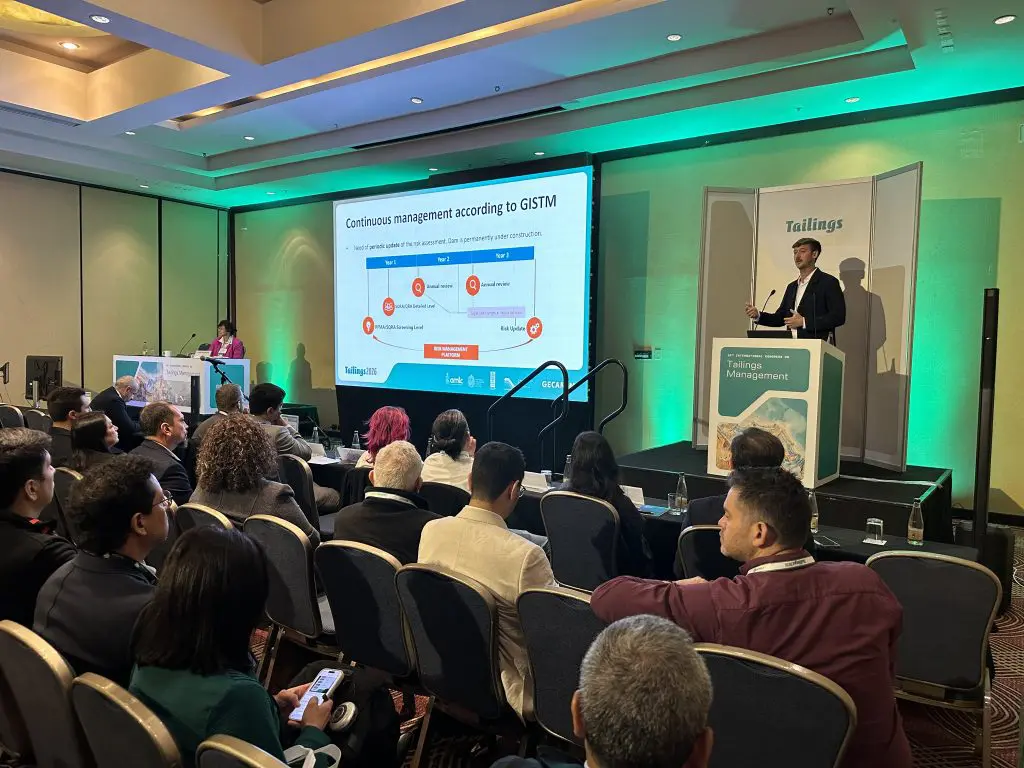
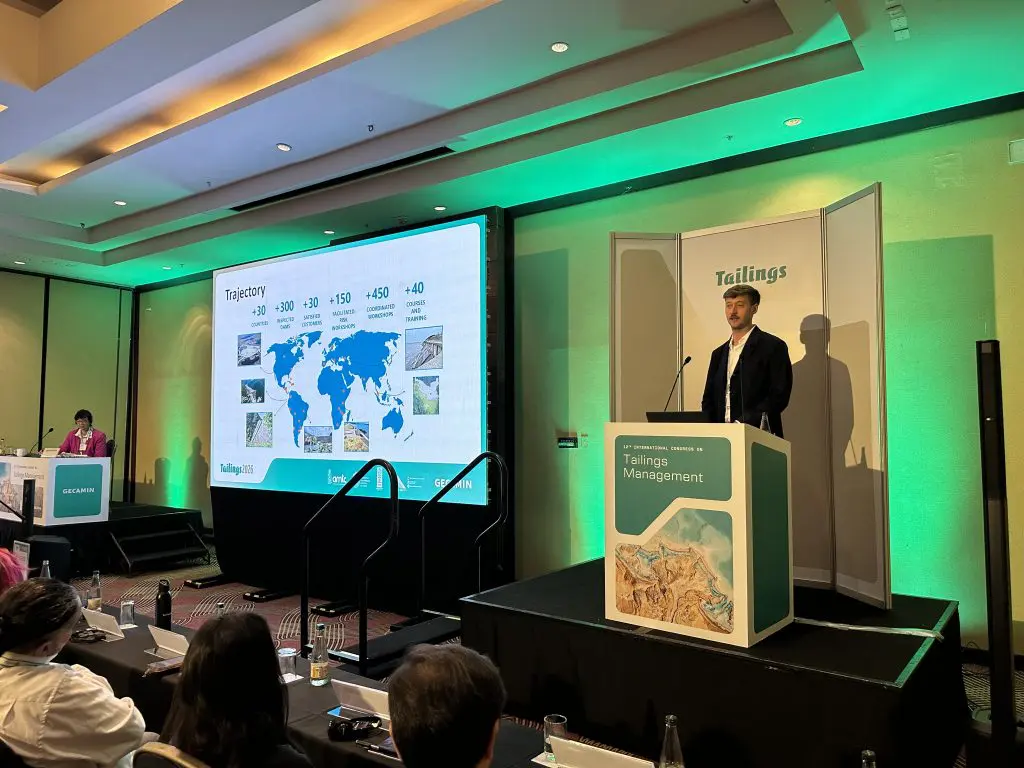
Francisco García Brook presented iPresas’ approach to integrating risk analysis into decision-making throughout the lifecycle of tailings dams and facilities at the 12th International Conference on Tailings Management (Tailings 2026).
The presentation, entitled “Continuous Risk Management for Tailings Facilities to Support Decision Making under GISTM”, addressed how to keep risk assessments up to date and use them to guide safety improvements at tailings facilities, in line with the Global Industry Standard on Tailings Management (GISTM).
The work, authored by Adrián Morales Torres, Ignacio Escuder Bueno, Luis Altarejos García and Francisco David García Brook, conveys a central message: tailings dams continually evolve, and risk management must evolve alongside them.
An analysis that evolves with the facility
Changes in geometry, operating conditions and available information can alter a facility’s risk. The presentation therefore highlighted the importance of periodically reviewing assessments and incorporating findings from new studies and monitoring.
iPresas presented a methodology comprising different levels of analysis, with the depth tailored to the needs of each case. Potential failure mode analysis and semi-quantitative risk assessment workshops help identify the main issues and information gaps, drawing on the participation of a multidisciplinary group that includes mine personnel, the Engineer of Record (EoR) team, and environmental and social specialists.
When specific scenarios require closer examination or significant investments need justification, the process can progress to a more detailed semi-quantitative or quantitative risk analysis. This enables loading conditions, the facility’s response and the consequences of a potential failure to be assessed together, taking account of the uncertainties affecting the results.
A practical case to support safety investments
The presentation illustrated this approach through a case in which an initial workshop identified the need for further hydrological and geotechnical investigations. Following a year of studies, monitoring and data collection, the updated analysis identified water management as the main risk driver.
The facility relied on a pumping system to recirculate water and had no capacity for external discharge. This prompted a quantitative risk analysis to compare improvement alternatives.
The results showed that introducing an emergency spillway reduced the probability of failure by several orders of magnitude across the scenarios analysed. The example demonstrated how updated knowledge can guide targeted studies and provide a technical basis for justifying investments.
Tools for continuous risk management
The presentation also featured iPresas’ web-based risk management platform, which enables users to compare failure modes, prioritise risk reduction measures and plan actions across a portfolio of facilities.
Through this approach, iPresas combines its technical experience and proprietary tools to help managers keep assessments up to date and use their results to inform safety decisions throughout the lifecycle of tailings facilities.