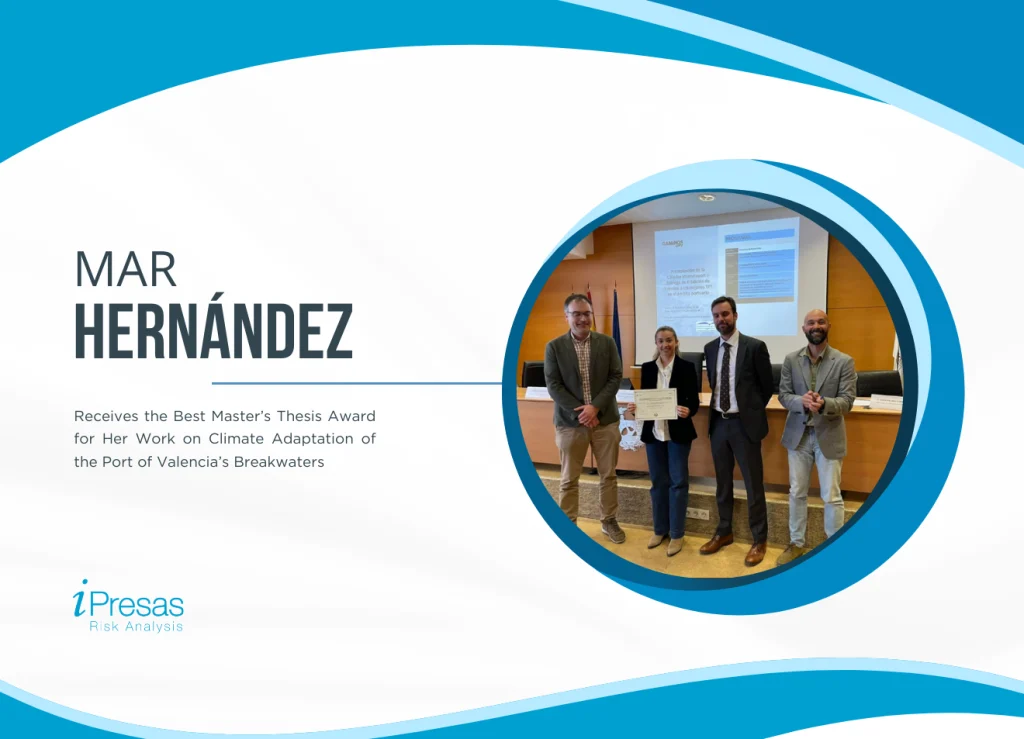
Author: Mar Hernández
Supervisors: Jorge Molines and Ignacio Escuder Bueno
Best Master’s Thesis Award – II Edition ValenciaPort Chair
Climate change is introducing new requirements in the design and management of port infrastructure. Rising mean sea levels, the possible intensification of storms, and increased uncertainty in sea states are forcing a reassessment of how the safety and functionality of breakwaters are evaluated—key elements in ensuring the operability of the Port of Valencia.
The Master’s Thesis developed by Mar Hernández, recognised with the Best Master’s Thesis Award in the II Edition of the ValenciaPort Chair, addresses this challenge from a strategic perspective: incorporating risk analysis as a key tool to prioritise adaptation measures.
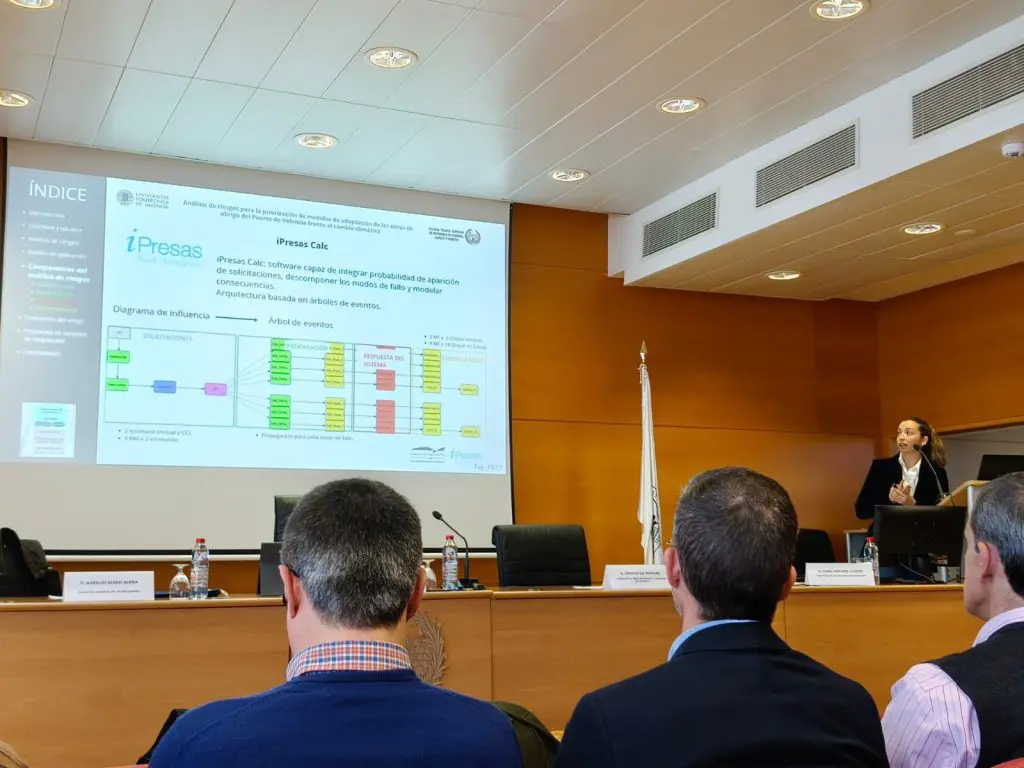
The study begins with the identification of the main climate threats and their potential future evolution, followed by an analysis of the structural and functional vulnerability of the breakwaters.
Based on this analysis, the work proposes a framework for comparing different adaptation alternatives—such as crest raising, structural reinforcements, or improvements to armour layers—according to their capacity to reduce risk and their relative efficiency. In this way, investment prioritisation moves beyond purely deterministic criteria and is instead supported by an integrated approach combining hazard, vulnerability and consequences.
This approach enables progress towards more resilient and adaptive management, aligned with international trends in planning critical infrastructure under climate change.
The award highlights not only the technical quality of the work, but also its practical applicability. Port adaptation can no longer be understood as a one-off intervention, but rather as a continuous risk management process.
Works such as that of our colleague Mar Hernández demonstrate that the answer lies in robust risk analysis methodologies capable of translating complex climate scenarios into concrete strategic decisions.
The port resilience of the future is being built today—through science, analysis and strategic vision.